
Dumpster Rental vs. Junk Removal: Which Makes Sense for Your Project?
Neither option is always better. The right choice depends on how much debris you have, whether you can load it yourself, how much time you have, your site's access, the material type, how long the project will run, and how each option is priced.
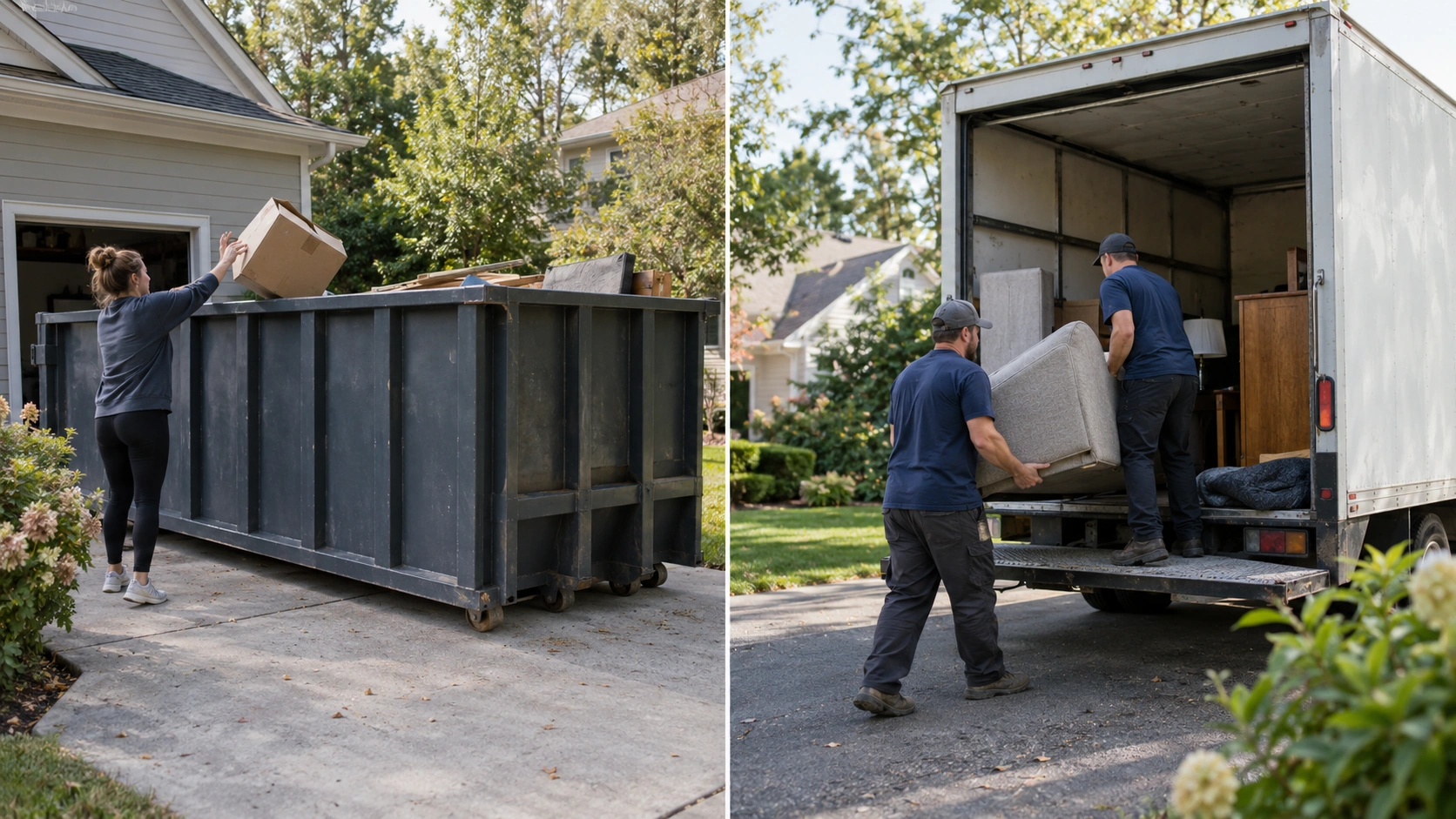
Dumpster Rental vs. Junk Removal
Dumpster rental often makes sense when you want a container on site and plan to load debris yourself, possibly over several days. Full-service junk removal may make more sense when you want a crew to remove and load items for you, usually in a single visit. Which one actually costs less or works better depends on your project size, labor needs, site access, the type of material involved, and provider pricing in each case — there's no universal winner between the two, and the right answer can change from one project to the next.
At-a-Glance Comparison
General tendencies, not fixed rules — actual policies vary by provider.
| Factor | Dumpster Rental | Junk Removal |
|---|---|---|
| Who loads debris? | Typically you or your crew | Typically the company's crew |
| Time on site | Usually left for a set rental period | Usually a single visit |
| Ongoing project use | Often suited to debris accumulating over time | Less suited to ongoing accumulation |
| Large cleanout | Can hold a large volume in one place | May take multiple loads or a larger crew |
| Labor requirement | You provide the loading labor | Labor is generally part of the service |
| Placement space | Needs a suitable container footprint | Generally no container footprint needed |
| Access considerations | Delivery truck needs access & clearance | Crew/vehicle still needs reasonable access |
| Pricing structure | Often size, duration & weight-based | Often volume & labor-based |
| Heavy/special materials | Subject to weight/material restrictions | Subject to what the company will handle |
| Best fit examples | Multi-day renovation, large self-loaded cleanout | Single-visit removal, no time/ability to load |
How Dumpster Rental Works
In short: a container is delivered to your property, you or your project crew load it over an agreed period, and pickup is arranged once you're done. Provider policies on timing, weight, and pickup vary.
See the full rental process guideHow Junk Removal Typically Works
Generally, a crew arrives, evaluates what you want removed, and handles the loading and removal as part of the service. Exact policies, labor scope, and which materials are accepted vary by company — not every junk removal service works identically.
When Dumpster Rental May Make More Sense
- A multi-day renovation generating debris gradually
- An ongoing cleanout you're working through over time
- An estate cleanout with a large volume to sort and remove
- A contractor project with continuous debris output
- A large amount of debris you're comfortable loading yourself
- A project where debris accumulates gradually rather than all at once
When Junk Removal May Make More Sense
- A small-to-medium one-time removal
- You can't or don't want to load debris yourself
- Furniture or appliance removal, where the service accepts those items
- No practical area to place a container
- You want a fast, single-visit removal
Not every item is necessarily accepted — confirm with the specific company.
Labor: Who Does the Loading?
With dumpster rental, you or your project crew generally handle loading. With junk removal, labor and loading are commonly part of the service. This difference can materially change the real cost-and-value comparison — a lower dumpster rental quote can end up costing more of your own time and effort than a junk removal quote that includes labor, depending on how much you value that time.
Project Duration
Dumpster rental may be useful when debris accumulates during a renovation, cleanout, construction project, or yard work — you fill it as you go. Junk removal may suit a pile that's already ready to go in a single visit. Actual rental periods and junk removal scheduling both vary by provider.
Cost Comparison — Without Invented Numbers
Dumpster Rental Quotes May Depend On
- Container size
- Rental duration
- Debris weight
- Disposal charges
- Overage terms
Junk Removal Pricing May Depend On
- Debris volume
- Labor required
- Material type
- Site access
- The company's pricing model
Neither option is always cheaper — it depends on your specific project. See the full dumpster cost & pricing guide.
Dumpster Rental vs. DIY Dump Runs
DIY Dump Runs May Involve
- Pickup truck or trailer availability
- Fuel
- Disposal charges paid directly
- Multiple trips
- Your own loading and unloading time
Dumpster Rental May Involve
- A rental quote
- Placement space
- Your own loading
- Weight and material restrictions
DIY dump runs tend to fit small amounts of debris you can handle in a trip or two; a dumpster tends to fit projects that keep generating debris over days or weeks.
Dumpster Rental vs. Dumpster Bag
A dumpster bag — a bag-style debris container some companies offer — may suit smaller debris volumes, projects where that kind of service is available in your area, and properties with suitable placement for a bag rather than a full roll-off. Considerations include the bag's capacity, pickup availability, what materials it accepts, and any lifting or access requirements. This page doesn't state specific brand pricing, dimensions, or service availability for any bag product — confirm those details directly with whichever company you're considering.
Dumpster Rental vs. Trailer
A trailer may make sense when you already own or have access to one, the debris amount is manageable, towing and transport are suitable for your situation, and repeated disposal trips are practical for you. Dumpster rental can reduce the number of trips needed but requires suitable placement space and coordinating with a provider. This page doesn't provide towing guidance or load-safety instructions — follow manufacturer and vehicle guidance for any towing situation.
Project Decision Matrix
More than one option can work for the same scenario — this is a starting point, not a single rigid answer.
| Scenario | Option(s) Worth Considering | Why |
|---|---|---|
| One couch + a few items | Junk removal, DIY dump run | Small volume; loading labor may matter more than a container |
| Garage cleanout | Dumpster rental, junk removal | Depends on volume and whether you want to load it yourself |
| Whole-home cleanout | Dumpster rental | High volume, often better suited to loading over time |
| Estate cleanout | Dumpster rental, junk removal | Depends on sorting pace, volume, and available help |
| Kitchen renovation | Dumpster rental | Debris accumulates over the project's duration |
| Roofing/construction | Dumpster rental | Weight and volume typically favor an on-site container |
| Yard cleanup | Dumpster rental, DIY dump run | Depends on volume and whether you have a suitable vehicle |
| Small amount of trash | DIY dump run, existing collection | May not justify a container or a service visit |
| Debris accumulating over several days | Dumpster rental | On-site container avoids repeated trips |
| Can't physically load debris | Junk removal | Labor is part of the service |
Access & Placement Can Change the Decision
A dumpster needs suitable placement space and truck access for delivery and pickup. Junk removal still needs reasonable access for the crew and their vehicle, but doesn't require a roll-off container's footprint sitting on your property. If placement space is limited or truck access is a real constraint, that can shift the decision.
See the full placement & driveway guideMaterial Type Can Change the Decision
Neither dumpster rental nor junk removal means every material is automatically acceptable. Special considerations include:
Paint/chemicals
Batteries
Electronics
Tires
Appliances
Heavy debris
Asbestos/suspect materials
Medical/biohazard waste
When You May Not Need Either
Sometimes neither a dumpster nor a junk removal service is the right tool. This can include:
- A very small amount of debris that fits a normal approved collection method
- Reusable or donatable items that could go to another use instead of disposal
- Recyclable materials with a dedicated recycling route
- Material that requires specialist handling rather than general disposal
- Material covered by another legitimate local disposal option
Questions to Ask Before Choosing
How much material is there?
A rough volume estimate.
Will more debris accumulate?
Ongoing vs. one-time.
Can I load it myself?
Physical ability and available time.
How quickly must it disappear?
Timeline expectations.
Is there space for a container?
Placement and truck access.
Is the debris heavy?
Weight can affect both options differently.
Are there special materials?
Items needing separate handling.
Will multiple dump trips be necessary?
For a DIY comparison.
Do I already have a suitable truck/trailer?
Relevant to the DIY option.
How is each option priced?
Ask each provider directly.
What's included?
Confirm scope before comparing quotes.
What restrictions apply?
Materials each option won't take.
Common Decision Mistakes
- Comparing headline price onlyWithout accounting for labor, weight, or included scope.
- Ignoring laborYour own time has real value.
- Ignoring weightCan turn a good dumpster deal into a costly one.
- Underestimating dump runsDIY trips often take more time than expected.
- Choosing a dumpster with no placement spaceNot viable regardless of price.
- Assuming junk removal accepts everythingSome materials still need separate handling.
- Assuming dumpster rental accepts everythingSame caution applies here too.
- Ignoring project durationA one-time service doesn't fit an ongoing project well.
- Not considering donation/recyclingSometimes the best option is neither.
Asheville Context
Property cleanouts, renovations, and yard or storm-related work all come up regularly around Asheville, and access constraints on some properties can be a real factor in which option makes sense. This page doesn't compare local junk removal pricing, since that hasn't been independently verified here.
Comparison FAQ
Is it cheaper to rent a dumpster or hire junk removal?
It depends on debris volume, whether you can load it yourself, and provider pricing. Dumpster rental can be more cost-effective when you handle the loading, while junk removal includes labor to do it for you.
When should I rent a dumpster?
When you have a larger or ongoing project, are comfortable loading debris yourself, and have suitable placement space on your property.
When is junk removal better?
When you need labor to do the loading, want a fast single-visit removal, or don't have space for a container. "Better" depends on your specific situation, not a universal rule.
Is it cheaper to go to the dump or rent a dumpster?
It depends on debris volume, number of trips required, your vehicle, and the value of your time. Small amounts can be more cost-effective as DIY trips; larger amounts often favor a single container.
What is the cheapest way to get rid of a lot of junk?
There's no single universal answer — it depends on volume, labor availability, and access. Compare dumpster rental, junk removal, and DIY options against your specific project rather than assuming one is always cheapest.
Do I have to load a rental dumpster myself?
Generally yes — dumpster rental typically leaves loading to you or your project crew, unlike junk removal, which usually includes labor as part of the service.
Is a dumpster bag cheaper than a dumpster?
It can be, for smaller volumes, but this depends on the specific bag service and your provider's dumpster pricing. This page doesn't state specific bag pricing — compare quotes directly for your situation.
Should I use a trailer instead of renting a dumpster?
If you already have access to a suitable trailer and the debris amount is manageable, a trailer can work well. For larger volumes or repeated trips, a dumpster may reduce the overall effort.
What if I only have a few bulky items?
Junk removal or a DIY dump run often fits better than a full dumpster rental for just a few items, since a container may be more capacity than you need.
What if my project lasts several days?
A dumpster rental is often a better fit for multi-day projects, since it gives you an on-site container to load gradually rather than scheduling a service visit for a pile that isn't ready yet.
Final Decision Summary
- Dumpster rental may fitOngoing, self-loaded, or high-volume projects.
- Junk removal may fitLabor-needed or single-visit projects.
- DIY, a bag, or a trailer may fitSmaller or highly specific situations.
- Special waste may requireA different disposal route entirely.
Still Not Sure Which Option Fits?
Describe your project, the debris involved, roughly how much there is, how long it will take, and your site's access — we'll help you think it through.