
Dumpster Placement & Driveway Guide for Asheville, NC
Picking a size is only part of the planning — the container and the delivery truck both need a suitable, accessible spot to work with. Here's what to check on your property before delivery day.
- Why the truck needs more room than the container alone
- What to check for slope, surface, and overhead clearance
- A practical checklist to work through before booking
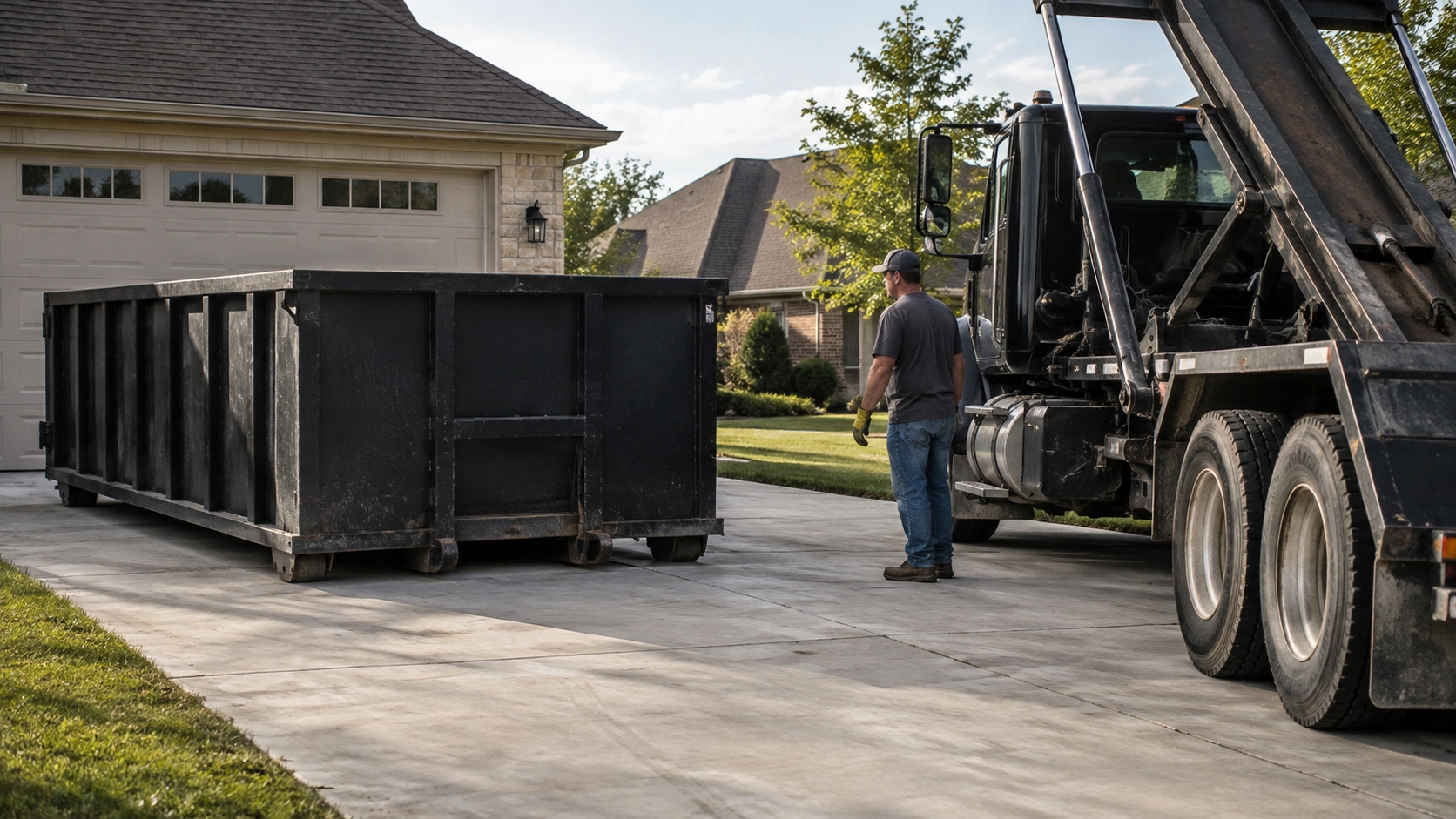
Can a Dumpster Fit in My Driveway?
Usually, but it comes down to several things at once: the container's actual dimensions, your driveway's width and length, slope, surface condition, overhead clearance, and any parked vehicles in the way. There's no blanket yes — the sections below cover what to check on your own property before booking.
Space You Actually Need: Width, Length & Overhead Clearance
The space the dumpster occupies isn't the same as the space needed to get it there — this is where most planning gaps happen.
Ground-Level Space
- Usable width & lengthNot just the driveway's total size, but what's actually clear of obstacles, plus room for the truck to approach and maneuver.
- Curves & narrow entry pointsGates, columns, or a curved driveway can change what's possible even if the total space looks adequate.
- Parked vehicles & landscapingCars, plants, and borders that narrow the usable space.
- Walls, fences & garage accessFixed structures that limit turning room, and whether the garage door needs to stay usable.
Overhead Clearance
Easy to miss because it's not at eye level: tree branches, utility lines, building overhangs, signage, and carports can all rule out a spot that looks fine from the ground.
If a utility line is anywhere near the placement area, that's for the utility company or a qualified professional to handle — not something to work around yourself.
Exact clearance needs vary by provider and equipment, so give your provider real measurements rather than an estimate. See the size guide for how container capacity relates to footprint.
Common Placement Locations
Roll-off containers are generally placed on private property — driveways, private parking areas, commercial lots, construction sites, or another suitable surface on your own property.
Placement on a public street or right-of-way is a different situation with its own rules — see the permit & placement guide.
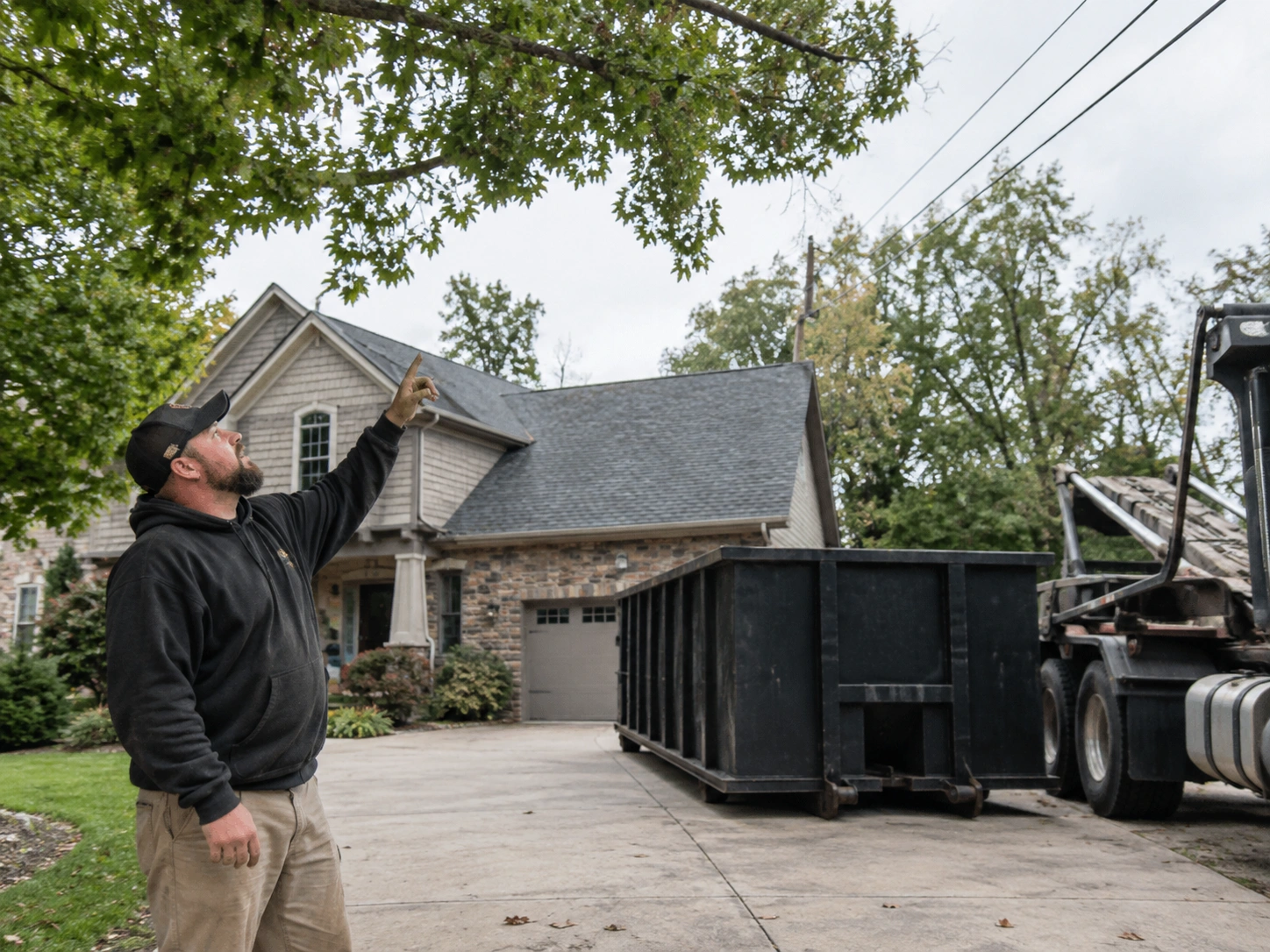
Surface, Slope & Driveway Protection
Slope & Ground
Steep slope, wet or soft soil, and loose ground can all complicate placement, and asphalt, concrete, and gravel each behave differently under a loaded container. Sloped, uneven lots come up often around Asheville, so it's worth checking rather than assuming a flat surface. Rain can turn a fine surface soft between when you check it and when the truck arrives — a provider may simply not be able to place a container on ground that isn't stable enough.
Can a Dumpster Damage a Driveway?
It's possible. Container and truck weight, driveway condition, surface material, heat, and how carefully the container is placed all play a role — an older or already-cracked surface is more at risk than one in good shape. If your driveway is in questionable condition, raise it with your provider before delivery rather than after.
Driveway Protection
Some providers use protective boards at contact points to ease the load on a surface, but this isn't universal and isn't a guarantee against damage — surface condition and placement still matter more. If protection matters to you, ask what your provider actually does rather than assuming either way.
Keeping Access Clear — Before and During Delivery
Before Delivery
- Move vehicles out of the placement and approach area
- Open or unlock any gates that need it
- Clear equipment or materials from the intended spot
- Check overhead branches one more time
- Flag any unusual site conditions to your provider ahead of time
Once It's Placed
Think past delivery day to the full rental period — will the container block a garage door, walkway, gate, deliveries, contractor access, emergency access, or a shared driveway? Planning for the whole rental, not just the drop-off, avoids the container becoming an obstacle later.
Commercial & Construction-Site Placement
Active sites add their own considerations beyond a residential driveway:
- Worker & customer trafficPlacement that doesn't interfere with crew movement or, at commercial properties, entrances and walkways.
- Parking & loading zonesBalancing container placement against existing needs.
- Equipment & gatesMachinery that may need to move, and access points that need coordinating.
- Pickup routeKeep a clear path for eventual pickup, not just delivery.
Placement close to the debris source, without disrupting site flow, tends to work best. See the commercial & contractor page or construction & renovation page for more.
Public Right-of-Way & Private Property Rules
Placing a dumpster on a public street, sidewalk, alley, or right-of-way can involve different permitting than private property, and requirements vary by jurisdiction — current Asheville and Buncombe County rules aren't detailed on this page. See the permit & placement guide and confirm with the appropriate authority before planning public placement.
Separately, private rules can apply even when no government permit does — HOA covenants, lease terms, property-owner approval, or shared-driveway agreements. This page isn't legal advice; check what applies to your property or community, especially if you're a tenant or managing on someone else's behalf.
Before Delivery — Placement Checklist
Identify the preferred area
Where you'd like the container to sit.
Measure usable space
Actual width and length, not an estimate.
Consider the footprint
How much room your size choice will need.
Consider truck approach
The path the delivery vehicle will use.
Check slope & ground condition
Level enough, and stable enough, for safe placement.
Check overhead clearance
Branches, wires, and other obstacles.
Move vehicles & equipment
Clear the area in advance.
Check gates & fences
Any access points that need coordination.
Consider garage/walkway access
Whether placement could block regular use.
Check public vs. private property
Whether the spot is entirely on your property, and any HOA rules that apply.
A photo of the driveway and the proposed spot, plus rough measurements and any gate or slope details, can help your provider evaluate placement faster — not every provider requires it, but it rarely hurts to send it along with your quote request.
Common Placement Mistakes
- Focusing only on the dumpster's footprintThe truck needs room too.
- A parked car blocking the routeNot moved until delivery day.
- Low branches or wiresNot checked until the truck is already there.
- Unstable or soft groundNot evaluated before scheduling.
- Blocking a garage or gateNot thought through for the whole rental period, not just delivery day.
- Assuming street placement needs no approvalPublic right-of-way placement can involve separate rules.
- Not mentioning slope or access issues upfrontLeaves your provider to discover them on delivery day.
- Assuming protective boards guarantee no damageThey reduce risk, not eliminate it.
Placement Considerations Around Asheville
Sloped lots, mature tree cover, and tighter residential sites show up often enough around Asheville that the driveway, slope, and overhead checks above are worth doing carefully rather than assuming a standard flat driveway. These are planning notes, not a promise about how placement will go on any specific property.
Placement & Driveway Questions, Answered
Can a dumpster fit in my driveway?
Often, but it depends on the container's dimensions plus your driveway's width, length, slope, surface, and overhead clearance. Measuring your actual space and sharing it with your provider is the most reliable way to confirm.
How much space does a dumpster need?
Depends on the size and the specific unit's footprint, which can vary even within the same size category. See the size guide for how capacity and footprint relate.
How much space does the delivery truck need?
More than the container itself, generally — it needs room to approach, maneuver, and safely place or retrieve it. Exact clearance depends on the provider's equipment.
Can a dumpster damage my driveway?
It's possible, depending on driveway condition, surface material, weather, and placement method. An older or already-weakened surface is worth flagging to your provider before delivery.
Should I put plywood under a dumpster?
Some providers use protective boards, but it's not universal and isn't a guarantee against damage. Ask what your specific provider does.
Can a dumpster be placed on gravel or grass?
Possibly — it comes down to how stable and level the surface actually is. Loose gravel or soft, wet ground may not be suitable, so check with your provider rather than assuming either will work.
What if there are low branches or wires?
They can rule out that exact spot for safe delivery. If a utility line is involved, that's for the utility company or a qualified professional, not a DIY fix.
Can I put a dumpster in the street?
Sometimes, but it usually involves different permitting than private property. See the permit guide and confirm current requirements with the appropriate authority.
Do I need to be home for dumpster delivery?
Depends on the provider — some want someone available to confirm placement, some don't. Ask directly rather than assuming.
Not Sure Whether Your Spot Will Work?
Describe your location, available space, surface, slope, and any overhead obstacles, and we'll help you think it through.