
Dumpster Permit & Right-of-Way Guide for Asheville, NC
Whether a dumpster needs City approval mostly comes down to where it sits: on your own property, or somewhere that touches public street or right-of-way. Here's what's actually confirmed, and what you'll need to check yourself before scheduling delivery.
- What City of Asheville guidance currently says about street placement
- How private property differs from public right-of-way
- What to confirm before delivery, and with whom
Do I Need a Permit for a Dumpster in Asheville?
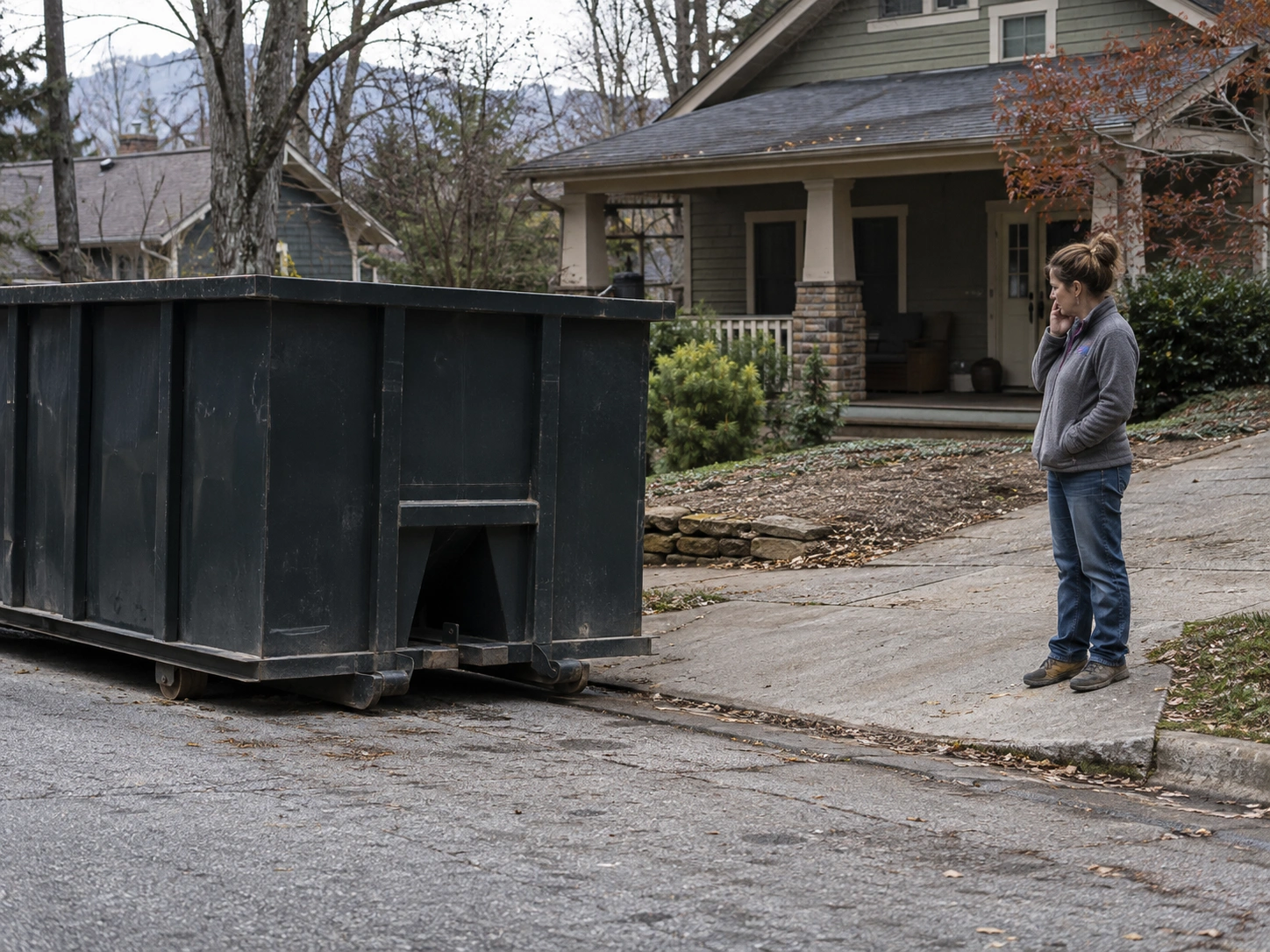
It's most relevant when the dumpster will sit in a public street, an on-street parking space, a sidewalk, or another public right-of-way. City of Asheville guidance specifically lists placing a dumpster in downtown on-street parking or on any street within city limits — for removing debris from a building renovation or other private-property work — as requiring a Temporary Closure Permit. If the dumpster is staying entirely on private property, don't assume either way; confirm with the City for your specific situation.
Private Property vs. Public Right-of-Way
Private Property
A driveway, a private parking area, or a construction site fully on private land. The public-street permit process isn't necessarily the only thing to consider here — property-owner permission, HOA rules, lease restrictions, your provider's own policy, and safe access can all matter too. That doesn't mean no permit is ever required for private property; confirm your situation rather than assume.
Public Right-of-Way
A street, an on-street parking space, a sidewalk, or a public alley. City approval becomes more directly relevant here — see the verified rule below.
What Asheville's Temporary Street Closures Guidance Says
City of Asheville Transportation Department guidance on Temporary Street Closures specifically lists placing a dumpster in downtown on-street parking spaces, or on any street within city limits, for removing debris from a building renovation or other private property, as an activity requiring a Temporary Closure Permit — including situations where a street, lane, or sidewalk needs to be temporarily closed for that work.
That's a specific rule about street and on-street parking placement, not a statement that every dumpster anywhere in Asheville needs a permit. Placement affecting a street or parking space matters here for practical reasons too — traffic flow, parking availability, sight lines, pedestrian access, and public safety all factor into why public-space placement typically involves more oversight than a container kept entirely on private property. City guidance names downtown on-street parking specifically as an example, but doesn't spell out details like meter rules, how many spaces can be used, or barricade requirements — those aren't independently verified here, so confirm them directly with the City for your location.
Right-of-Way & Encroachment Permits
Separately from the Temporary Closure Permit above, City of Asheville Public Works addresses permitting for objects or structures placed within the public right-of-way — roadsides and sidewalks — through a Right-of-Way Encroachment Permit process, administered through the City's Permit Application Center. "Temporary street closure" and "right-of-way encroachment" aren't interchangeable terms, and which one (or both) applies depends on your specific situation — a full street/lane closure is a different ask than an object sitting within the right-of-way without closing anything. This page doesn't claim that every dumpster placement uses the encroachment route specifically; the reliable way to find out is to describe your exact location — street name, whether a parking lane or sidewalk is affected, and how long the container will be there — when you contact the City, so they can point you to the correct process.
What About a Dumpster in My Driveway?
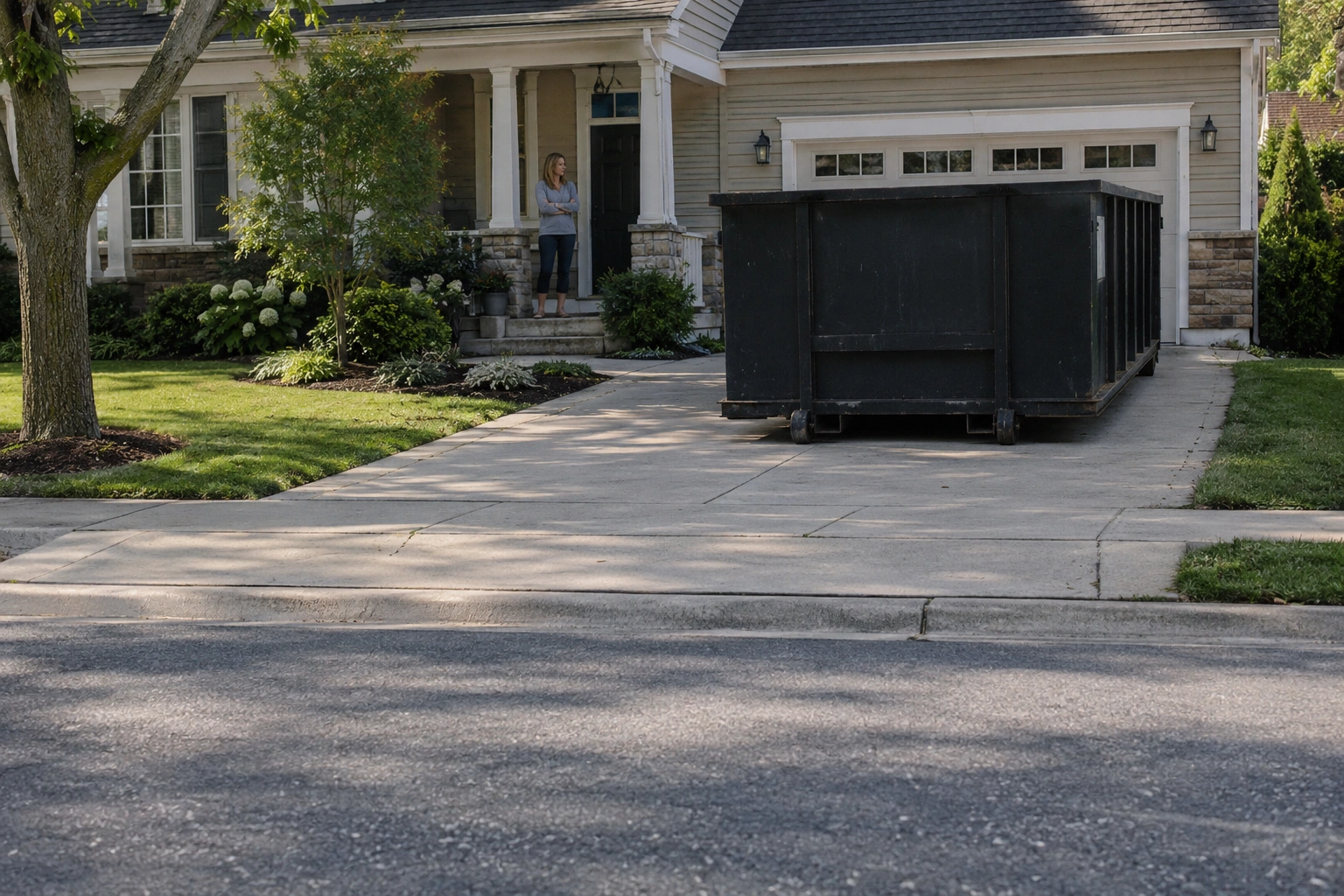
A container fully on private property is a different situation than one in the right-of-way, but that doesn't mean no permit is ever required for private placement — it depends on your situation. Beyond any City requirement, it's worth checking HOA or community rules, landlord approval if you're renting, and your provider's own placement policy, since a government permit and a private agreement are two separate things that can both apply.
One more wrinkle: even if the container itself ends up entirely on private property, the delivery truck might briefly need part of a street or sidewalk to maneuver into place. This page doesn't state a specific rule for that momentary use — if it seems likely for your site, it's worth asking both your provider and the City whether it triggers anything.
See the full placement & driveway guideOutside City Limits & State-Maintained Roads
An "Asheville" mailing address doesn't automatically mean a property falls under the City's permit process — plenty of Buncombe County properties sit outside the actual city limits, where jurisdiction and road ownership can be different. The same goes for any road controlled by another agency, such as a state-maintained road, rather than the City. This page doesn't state Buncombe County's or NCDOT's specific requirements, since that hasn't been verified here — confirm which agency actually controls the road or area before relying on City of Asheville guidance for it.
Permit Planning Before Requesting Delivery
Identify the exact location
Where precisely the container would sit.
Determine if it's fully private property
Or touches street, sidewalk, or public parking, even partially.
Consider traffic/pedestrian impact
Whether the placement could affect others' access.
Confirm road/jurisdiction
City of Asheville, the County, or another agency.
Contact the appropriate authority
If any public space is involved at all.
Have your details ready
Address, exact location, street name, expected duration, project type, and approximate container footprint.
Ask your provider too
Their own policies and local placement experience.
Check HOA/landlord rules
Separate from any government permit.
Allow time for approval
Before scheduling delivery, if a permit process applies.
Don't Book Street Placement Based Only on an Assumption
Before scheduling public-space placement, confirm rather than assume:
- "The provider handles it"
- "It's only for one day, so it doesn't matter"
- "It's outside downtown, so no permit applies"
- "There's obviously enough road space"
- "It's a private project, so public-space placement is unrestricted"
Permit Approval vs. Physical Placement Suitability
Getting a permit — where one applies — doesn't automatically mean the spot is operationally workable for the delivery truck. Truck access, overhead clearance, slope, and surface condition are separate physical questions that matter regardless of permit status.
See the full placement & driveway guidePermit rules, processes, forms, and fees can change, and this guide is general information rather than legal advice. Confirm current requirements with the City of Asheville or the authority responsible for your specific location before scheduling public-space placement.
See our disclaimer and editorial policy for more on how this page was prepared.
Permit & Placement Questions, Answered
Do I need a permit for a dumpster in Asheville?
It depends on placement — City guidance specifically requires a Temporary Closure Permit for dumpsters in downtown on-street parking or on any city street for private-property debris removal. Other situations should be confirmed directly with the City.
Do I need a permit if the dumpster is in my driveway?
Private-property placement is different from street placement, but that doesn't mean a permit is never required. Confirm your specific situation with the City, and check any HOA or landlord rules too.
Can I put a dumpster in the street in Asheville?
City guidance specifically addresses this — placing one on a street within city limits for private-property debris removal requires a Temporary Closure Permit. Confirm the exact process for your location with the City.
Can a dumpster occupy an on-street parking space?
City guidance names downtown on-street parking specifically as requiring a Temporary Closure Permit for dumpster placement. Confirm current requirements and how to apply directly with the City.
What if a dumpster blocks part of a sidewalk?
Sidewalks are part of the public right-of-way, and the City has permitting and encroachment processes for objects affecting them. Contact the City with your proposed location to find out which process applies.
Who is responsible for obtaining a dumpster permit?
It varies by situation and provider. Confirm with both your dumpster provider and the relevant authority who's expected to apply for or hold any required permit — don't assume it's automatically handled for you.
What if my property is outside Asheville city limits?
City of Asheville guidance may not apply the same way — jurisdiction, road ownership, and rules can differ outside the actual city limits. Confirm with the appropriate county or local authority for your property.
Does HOA approval replace a City permit?
No. HOA or community approval and a government permit are separate matters, and you may need both depending on your situation.
How early should I check permit requirements?
As early as possible, before scheduling delivery. Permit processes can take time, and finding out late can mean a delayed delivery or a placement that turns out not to be approved.
This page was prepared using current City of Asheville Transportation and Public Works guidance. Local rules can change; official government guidance controls.
Planning Street or Driveway Placement?
Tell us your address, preferred spot, whether it's private or public, and your project type, and we'll help you figure out next steps.